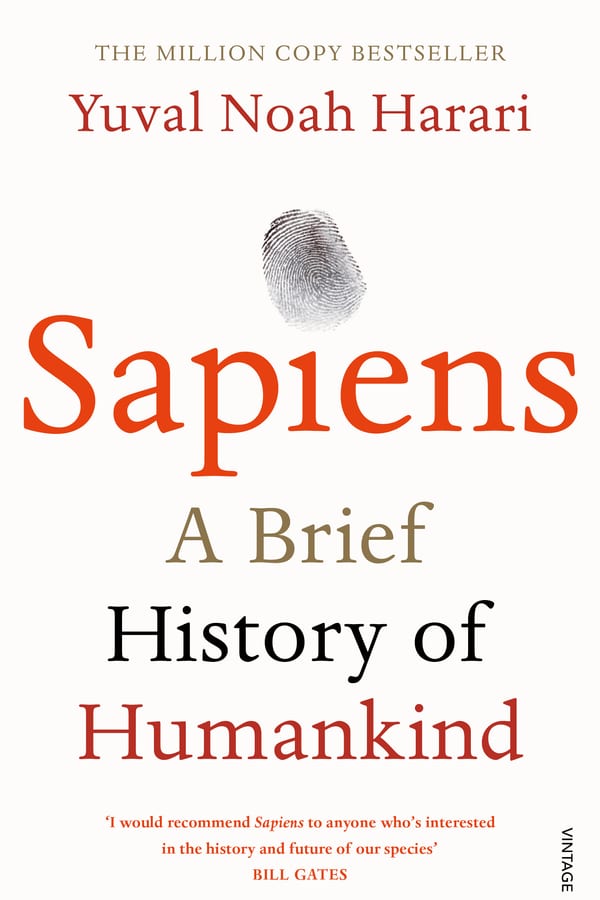
Sapiens: A Brief History of Humankind
by Yuval Noah Harari
This is a real Premium analysis — the exact report ProofBooks generates for your manuscript. Scroll to see every section.
Premium Analysis
Elite deep-dive — full manuscript
Sapiens is a landmark work of popular nonfiction that turns 70,000 years of human history into a single, propulsive argument: that shared fictions — money, religion, nations, human rights — are the operating system of our species. Its craft is exceptional at the level of synthesis and narrative voice; where it draws fire is scholarly caution, occasional over-reach on contested claims, and a final act that shifts from history to futurism. As a commercial and cultural proposition it is close to a category-definer.
Executive Editor Summary
Sapiens is the rare big-idea book that is simultaneously a bestseller, a book-club staple, and a cultural reference point. Its craft ceiling is set by voice and synthesis; its floor is set by scholarly caution. For an acquiring editor this is a near-automatic yes — the questions are positioning and defending against the 'too sweeping' critique, not whether it will sell.
“A sweeping, provocative history of how an unremarkable ape came to rule the planet by learning to believe in things that exist only in our collective imagination.”
Craft Scores
60% weight
Market Scores
40% weight
| Summary | Note | ||
|---|---|---|---|
| Ch. 2: The Tree of Knowledge | Introduces fictive language and 'shared myths' as the human superpower. | The intellectual heart of the book. Everything after this is application. | excellent |
| Ch. 5: History's Biggest Fraud | The Agricultural Revolution reframed as a trap that served wheat and elites, not individuals. | The book's most-quoted, most-taught chapter. | excellent |
| Ch. 10: The Scent of Money | Money presented as the most universal and efficient system of mutual trust ever devised. | A masterclass in making an abstract economic point feel vivid. | excellent |
| Ch. 11: Imperial Visions | The role of empire in unifying humankind. | Where momentum dips — strong ideas, flatter storytelling. | needs work |
| Ch. 20: The End of Homo Sapiens | Bioengineering and AI as the possible end of our species as we know it. | Thrilling but speculative — the section that most divides readers. | solid |
Intellectual tension rises rather than falls — the book saves its most destabilizing ideas for the end. The dip through the empire chapters is the one place attention can wander.
Emotionally the book trends darker as it goes — wonder is repeatedly undercut by cost. It leaves readers exhilarated and slightly disturbed, which is precisely why it travels by word of mouth.
Strengths
A single, portable Big Idea
clarityOfPurpose'Shared fictions run the world' is the kind of thesis a reader can repeat at dinner and apply everywhere. That transferability is the engine of the book's word-of-mouth.
A voice that makes 70,000 years feel urgent
voiceAndStyleWry, confident, aphoristic. Harari writes history like a thriller, deploying reversals and jokes exactly where a lesser writer would deploy a footnote.
Counter-intuitive reframings that reward the reader
originalityThe Agricultural Revolution as 'fraud', money as the most successful story ever told — each reframe gives the reader the pleasure of seeing something familiar made strange.
Weaknesses
Confidence outruns evidence in places
depthAndSubstanceThe book's persuasive voice sometimes states contested or speculative claims with the same certainty as settled ones, which specialists (and increasingly readers) push back on.
The genre shifts under the reader in Act Three
structuralIntegrityThe final chapters pivot from history to futurism. It's exhilarating but changes the contract — the evidentiary rigor that earned trust earlier is harder to apply to predictions.
Empire chapters lose narrative tension
readerEngagementThe unification-under-empire stretch is the one place the propulsive momentum sags and the reader's attention can drift.
Readability & Composition
11
Grade Level
Literary
The book that turned the whole history of humankind into a single unforgettable idea.
From an insignificant ape to the ruler of the planet — Sapiens explains how Homo sapiens conquered the world by inventing things that exist only in our shared imagination: gods, nations, money, and human rights.
One hundred thousand years ago, at least six human species inhabited the earth. Today there is just one. Us. Sapiens tells the story of how we won — not through strength or intelligence alone, but through our unique ability to believe in collective fictions. Weaving together history, biology, economics and philosophy in prose that reads like a thriller, Yuval Noah Harari challenges everything we thought we knew about being human, and asks the most urgent question of all: now that we have become gods, what do we want to become?
Amazon Browse Categories
Dear [Agent/Editor],
Six human species once walked the earth. Only one is left — and it won not by being stronger or smarter, but by learning to believe in things that don't exist.
Sapiens is a 400-page narrative history of humankind organized around a single provocative thesis: that shared fictions — money, religion, nations, corporations, human rights — are the technology that let Homo sapiens cooperate at scale and dominate the planet. Moving through the Cognitive, Agricultural, and Scientific Revolutions, it reframes 'progress' as a series of trade-offs and ends by asking what our new god-like powers will make of us.
[Author bio: [Author bio — credentials in history/anthropology, prior publications, platform]]
The complete manuscript is available on request. Thank you for your consideration.
Recommended Publishers
Epistemic signposting on the boldest contested claims (defensibility)
Third-act hinge to smooth the history→futurism shift
Human-scale anecdotes to lift the empire chapters
Total: 3–4 weeks
Amazon Product Description
**From a forgotten ape to the ruler of the world.** One hundred thousand years ago, at least six species of humans walked the earth. Today there is just one — us. How did our species win the battle for dominance? Why did our foraging ancestors come together to create cities and kingdoms? How did we come to believe in gods, nations and human rights; to trust money, books and laws; and to be enslaved by bureaucracy, timetables and consumerism? **Sapiens** spans the whole of human history, from the very first humans to walk the earth to the radical — and sometimes devastating — breakthroughs of the Cognitive, Agricultural and Scientific Revolutions. Drawing on insights from biology, anthropology, economics and history, it explores how the currents of history have shaped our human societies, the animals and plants around us, and even our personalities. A bold, wide-ranging and provocative investigation into who we are and where we are heading.
Content Advisory
Age Rating
14+ (general adult & upper-secondary readership)
Themes
Framing of religion as 'shared fiction' and critical treatment of empire may require sensitivity-aware forewords in some regional editions.
Next Steps
Add epistemic signposting to the 3–4 boldest contested claims.
Insert a one-page third-act hinge announcing the history→future shift.
Open the empire chapters with concrete human-scale anecdotes.
Exceptional — and already realized. The lens is a franchise engine, not a one-off.
Ready for submission
low riskMarket Risk: low
!Academic criticism of over-generalization can dent credibility with gatekeepers
!Religious-market sensitivity around 'religion as fiction'
!Category is crowded with imitators chasing the same lightning
+Lean into the voice — the criticism is also the marketing
+Regional editions with sensitivity-aware forewords where needed
+Original-author authority and first-mover status insulate against imitators
Your book deserves this analysis
Get a Premium ProofIntelligence report for your own manuscript — and protect it with tamper-proof timestamps that prove your authorship forever.
Free plan available. No credit card required.